Introduction
Marketing teams today are expected to do more with less. More personalization, more channels, more data, and more accountability for revenue. At the same time, customers expect timely, relevant communication that feels personal, not mass-produced. Marketing automation exists to bridge this gap.
At its simplest, marketing automation is about using software to automate repetitive marketing tasks. But in practice, it’s much more than that. It’s the system that connects customer behavior, data, and brand content or messaging into one coordinated engine that runs continuously in the background.
When implemented well, marketing automation helps businesses:
- Respond to customer actions in real time
- Personalize communication at scale
- Align marketing and sales around shared data
- Measure what’s working and what’s not
- Grow without proportionally increasing team size
This guide is written for marketers, founders, and growth teams who want a clear, practical understanding of marketing automation, free of jargon, hype, and vendor bias. You’ll learn how it works, why it matters, what tools exist, and how to implement it in a way that actually drives results.
Understanding Marketing Automation
What Is Marketing Automation?
Marketing automation is the use of technology to manage, execute, and optimize marketing activities automatically based on predefined rules and customer behavior.
Instead of manually sending emails, updating spreadsheets, assigning leads, or following up one by one, automation platforms do this work for you, consistently and at scale.
A simple example:
Someone visits your website, downloads a guide, and leaves their email address. With marketing automation:
- They immediately receive a welcome email
- They’re added to a relevant email sequence
- Their interest level is tracked based on what they read or click
- Sales is notified only if they show buying intent
All of this happens without a marketer manually intervening at each step.
From Manual Marketing to Automated Systems
Before marketing automation, most teams relied on:
- One-off email blasts
- Static lists
- Manual follow-ups
- Gut feeling instead of data
This approach worked when audiences were smaller and expectations were lower. But as digital channels multiplied and customer journeys became non-linear, manual marketing stopped scaling.
Marketing automation evolved as a response to three major challenges:
- Volume – Too many leads, too many touchpoints
- Complexity – Customers moving across devices and channels
- Accountability – Pressure to prove ROI
Automation introduced structure, consistency, and measurability into marketing operations.
Core Principles Behind Marketing Automation
While tools vary, successful marketing automation services is built on a few core principles:
- Behavior-driven marketing
Actions trigger responses. What a user does matters more than who they are.
- Lifecycle thinking
Customers move through stages-from awareness to purchase to retention-and messaging should change accordingly.
- Personalization at scale
Automation allows messages to feel personal without being manually written each time.
- Data as the foundation
Clean, connected data is what makes automation intelligent instead of spammy.
Marketing Automation vs Traditional Marketing
Traditional marketing is campaign-centric. Marketing automation is customer-centric.
Traditional campaigns ask:
“What message do we want to send this week?”
Automation asks:
“What does this person need right now based on their behavior?”
That shift alone is what makes automation so powerful.
How Marketing Automation Works?
At the heart of every marketing automation system is a workflow.
A workflow is a set of rules that tells the system:
- When to act
- What action to take
- Who should receive it
- What happens next
The Basic Workflow Logic
Most automation workflows follow this pattern:
Trigger → Condition → Action → Outcome
For example:
- Trigger: A user signs up for a newsletter
- Condition: If they are a first-time subscriber
- Action: Send a welcome email and tag them as “New Lead”
- Outcome: Start a nurture sequence
These workflows can be simple or extremely complex, depending on business needs.
Key Components Explained Simply
- Triggers
Events that start a workflow (form submission, purchase, page visit)
- Actions
What the system does (send email, update CRM, assign score)
- Conditions
Logic checks (if/else rules based on behavior or data)
- Delays
Time gaps between actions (wait 2 days, wait until next visit)
- Branches
Different paths based on user behavior
How Data Moves Through the System?
Marketing automation doesn’t work in isolation. It connects multiple systems:
- Website and landing pages
- CRM
- Email platform
- E-commerce system
- Analytics tools
When a user interacts with any of these, data flows into a central profile. Every click, visit, or purchase updates that profile in real time. The automation engine then uses this data to decide what happens next.
Real-World Workflow Examples
- Welcome Series
New subscribers receive a structured sequence introducing the brand, products, and value proposition.
- Lead Nurturing
Leads receive educational content until they show buying intent, then get passed to sales.
- Cart Abandonment
Shoppers who leave without purchasing receive reminder emails or messages.
- Post-Purchase Follow-Up
Customers receive onboarding tips, upsell offers, or review requests automatically.
Types of Marketing Automation
Marketing automation is not one-size-fits-all. How it’s used depends heavily on the business model.
B2B Marketing Automation
B2B automation focuses on:
- Long sales cycles
- Multiple decision-makers
- Lead qualification and scoring
- Sales and marketing alignment
The goal is not instant conversion, but education, trust, and timing.
B2C Marketing Automation
B2C automation prioritizes:
- Speed and scale
- Behavioral triggers
- Personalization
- High-volume interactions
Here, automation is often tied closely to e-commerce and customer lifecycle marketing.
Email Marketing Automation
This is the most common entry point. It includes:
- Drip campaigns
- Transactional emails
- Re-engagement sequences
- Event-based emails
Despite being “old,” email remains one of the highest-ROI automation channels.
Social Media Automation
Used for:
- Scheduling posts
- Tracking engagement
- Triggering retargeting campaigns
It’s less about conversation and more about coordination.
Lead Nurturing Automation
This type focuses on gradually moving leads toward conversion by delivering the right content at the right time.
Customer Journey Automation
The most advanced form, where multiple channels-email, SMS, ads, website content-are orchestrated into a single experience.
Marketing Automation History & Evolution
Marketing automation didn’t appear overnight. It evolved alongside digital marketing itself.
Early Days: CRM and Email Tools
The first wave focused on:
- Contact databases
- Simple email autoresponders
- Basic segmentation
Useful, but limited.
Rule-Based Automation
Next came rule engines:
- “If user does X, send Y”
- Lead scoring models
- Scheduled drip campaigns
This is when automation became strategic, not just operational.
Modern Automation Platforms
Today’s platforms offer:
- AI-driven predictions
- Real-time personalization
- Cross-channel orchestration
- No-code workflow builders
The Role of AI Today
AI enhances automation by:
- Predicting buyer intent
- Optimizing send times
- Recommending content
- Improving segmentation automatically
Instead of marketers guessing, systems now learn from data.
Benefits & ROI of Marketing Automation
Marketing automation only matters if it produces measurable business outcomes. This section focuses on what actually improves when automation is implemented correctly-and how to evaluate whether it’s worth the investment.
Business Benefits
Increased Efficiency and Productivity
One of the most immediate benefits of marketing automation is time savings. Tasks that previously required daily manual effort-sending follow-ups, tagging leads, updating CRM records, segmenting lists-are handled automatically.
For most teams, this doesn’t mean doing less work. It means doing higher-value work. Marketers spend less time executing campaigns and more time:
- Improving messaging
- Analyzing performance
- Testing new ideas
- Collaborating with sales and product teams
Automation also removes inconsistency. A workflow executes the same way every time, regardless of workload, time zone, or team changes.
Cost Savings and Resource Optimization
Automation reduces dependency on manual labor as volume increases. Without it, growth often means hiring more people just to keep up with operational tasks.
With automation:
- One campaign can serve thousands of users simultaneously
- Follow-ups happen without human intervention
- Fewer leads fall through the cracks
Over time, this lowers the cost per lead and cost per customer, not by cutting spend, but by using existing resources more effectively.
Scalability for Growing Businesses
Manual marketing breaks when scale increases. Automation doesn’t.
Whether you have 500 leads or 500,000, the same workflows can run in the background. This makes automation especially valuable for:
- Fast-growing startups
- Seasonal businesses
- E-commerce brands with fluctuating demand
- SaaS companies onboarding large volumes of users
Scalability isn’t just about volume-it’s about maintaining experience quality as volume grows.
Improved Data Accuracy and Visibility
Marketing automation platforms act as a central source of truth for customer data. Instead of information scattered across spreadsheets and tools, interactions are tracked in one system.
This improves:
- Reporting accuracy
- Attribution modeling
- Decision-making confidence
When data flows automatically between systems, there’s less room for human error and outdated information.
Stronger Sales and Marketing Alignment
Misalignment between sales and marketing often comes down to poor visibility and unclear handoffs.
Automation helps by:
- Defining what qualifies as a sales-ready lead
- Automatically notifying sales at the right time
- Tracking lead history so sales team knows what the prospect has already seen
This reduces friction and increases trust between teams.
Better Customer Experience
From the customer’s perspective, automation improves relevance and timing.
Instead of generic campaigns, users receive:
- Messages based on what they actually did
- Content aligned with their stage in the journey
- Follow-ups that feel timely, not intrusive
When done correctly, automation feels helpful, not automated.
Quantifiable Results
The value of marketing automation becomes clearer when measured through outcomes, not features.
Lead Generation Improvements
Companies using automation typically see:
- Higher lead volume due to better capture and follow-up
- Higher lead quality due to behavioral targeting
- More consistent lead flow across time
Because no lead is ignored or delayed, response time improves-and response time directly impacts conversion.
Conversion Rate Increases
Automation improves conversion rates by:
- Delivering relevant content instead of generic messaging
- Following up immediately after user actions
- Removing manual delays from the funnel
Even small improvements at each stage of the funnel compound into meaningful revenue gains.
Time Savings
Common areas where teams save time:
- Campaign execution
- List segmentation
- Lead assignment
- Reporting
These savings are not just operational-they create room for strategic thinking and experimentation.
Revenue Impact
Automation influences revenue by:
- Increasing conversion rates
- Shortening sales cycles
- Improving retention and repeat purchases
While automation rarely drives revenue alone, it improves every step that leads to revenue.
Customer Retention Improvements
Retention improves when customers receive:
- Timely onboarding communication
- Relevant product education
- Proactive support and re-engagement
Automation ensures these touchpoints happen consistently.
ROI Calculation Framework
To evaluate marketing automation properly, ROI must be calculated beyond surface-level metrics.
Step 1: Define Clear Objectives
Common automation goals include:
- Increasing qualified leads
- Reducing sales cycle length
- Improving retention
- Lowering acquisition costs
Without a defined objective, ROI becomes impossible to measure accurately.
Step 2: Track the Right Metrics
Key metrics typically include:
- Leads generated and qualified
- Conversion rates by stage
- Revenue influenced by automation
- Customer lifetime value
- Time saved per campaign
Metrics should align with the original business goal.
Step 3: Calculate ROI
A simple formula:
ROI = (Revenue Attributed to Automation – Total Automation Costs) ÷ Total Automation Costs
Costs should include:
- Platform subscription
- Implementation and onboarding
- Training
- Ongoing maintenance
Revenue should be attributed conservatively to avoid inflated results.
Step 4: Set a Realistic Timeline
Marketing automation rarely shows full ROI in the first month.
Typical timeline:
- 1–2 months: Operational efficiency gains
- 3–6 months: Conversion and lead quality improvements
- 6–12 months: Clear revenue impact
Automation is a long-term system, not a quick campaign.
Common Challenges & How to Overcome Them
Implementation Complexity
Many teams underestimate the planning required. Automation amplifies existing processes, good or bad.
How to address it:
- Start with one or two core workflows
- Document processes before automating
- Avoid trying to automate everything at once
Poor Data Quality
Automation depends on clean, reliable data. Bad data leads to bad outcomes.
How to address it:
- Clean databases before implementation
- Define data standards early
- Schedule regular data audits
Team Resistance and Low Adoption
Automation changes how people work, which can create resistance.
How to address it:
- Involve teams early
- Show quick wins
- Provide practical training, not just documentation
Over-Automation
Too much automation can feel impersonal and damage trust.
How to address it:
- Keep human checkpoints in key stages
- Focus on relevance, not frequency
- Regularly review customer feedback
Marketing Automation Features & Capabilities
Marketing automation platforms often advertise long feature lists, but not every feature matters equally. What matters is how these capabilities work together to support real marketing objectives. This section breaks down core features you actually need, followed by advanced capabilities that add value once the basics are solid.
Core Features
These features form the foundation of any functional marketing automation system. Without them, automation is limited or fragmented.
Email Marketing Automation
Email remains the backbone of marketing automation because it is:
- Direct
- Measurable
- Behavior-driven
Email automation allows teams to send messages based on:
- Time (drip campaigns)
- Actions (downloads, clicks, purchases)
- Status changes (lead becomes customer)
Effective platforms support:
- Visual workflow builders
- Personalization tokens
- Trigger-based sends
- Transactional and marketing emails in one system
Email automation is not about sending more emails. It’s about sending fewer, more relevant ones.
Lead Scoring and Qualification
Lead scoring assigns value to actions and attributes to estimate buying intent.
Examples:
- Visiting pricing page: +10 points
- Downloading a product guide: +15 points
- Job title matches buyer profile: +20 points
Once a lead crosses a defined threshold, they can:
- Be flagged as sales-ready
- Enter a high-intent nurture track
- Trigger alerts to sales teams
This prevents sales from chasing cold leads and improves conversion efficiency.
Segmentation and Personalization
Segmentation allows marketers to group users based on:
- Demographics
- Behavior
- Lifecycle stage
- Engagement level
Automation platforms enable dynamic segmentation, meaning users move in and out of segments automatically as their data changes.
Personalization then uses these segments to:
- Adjust messaging
- Modify subject lines
- Change content blocks
Without segmentation, automation becomes mass messaging.
Campaign Management
Campaign management features allow teams to:
- Plan multi-step campaigns
- Coordinate across channels
- Track performance holistically
Instead of measuring isolated emails, campaigns group activities around a shared goal, making reporting more meaningful.
Landing Pages and Forms
Most platforms include tools to create:
- Lead capture forms
- Gated content pages
- Event registration pages
These assets connect directly to workflows, ensuring that every submission triggers the right follow-up.
The key value here is not design flexibility, but tight integration with data and automation logic.
A/B Testing
A/B testing allows marketers to test:
- Subject lines
- Email content
- Send times
- Calls to action
Automation platforms handle:
- Traffic distribution
- Result tracking
- Winner selection
Over time, this improves performance without increasing workload.
Advanced Features
Once core automation is stable, advanced capabilities help improve efficiency and personalization further.
Predictive Analytics
Predictive analytics uses historical data to forecast future behavior.
Common use cases:
- Predicting which leads are most likely to convert
- Identifying churn risk
- Estimating lifetime value
This helps teams prioritize effort instead of treating all users equally.
AI-Powered Recommendations
AI-driven systems can suggest:
- Best content to send next
- Optimal send times
- Recommended products or offers
These recommendations reduce guesswork and improve relevance, especially in large datasets.
Multi-Channel Orchestration
Advanced automation coordinates multiple channels:
- SMS
- Push notifications
- Paid ads
- On-site messaging
The goal is consistency. A user shouldn’t receive conflicting messages across channels.
Multi-channel orchestration ensures:
- Sequencing across platforms
- Frequency control
- Unified customer experience
Dynamic Content
Dynamic content changes based on user attributes or behavior.
Examples:
- Different email sections for new vs returning customers
- Website banners tailored to lifecycle stage
- Offers adjusted by location or purchase history
This allows personalization without creating separate campaigns for every audience.
Behavioral Triggers
Behavioral triggers respond to real-time actions such as:
- Page visits
- Scroll depth
- Time spent on content
- Product views
These triggers enable timely responses that feel contextual rather than scheduled.
Progressive Profiling
Progressive profiling collects data gradually instead of all at once.
For example:
- First form: email only
- Second interaction: role or interest
- Later interactions: company size or preferences
This improves conversion rates while still enriching customer profiles over time.
Real-Time Personalization
Some platforms support real-time decision-making, adjusting content instantly based on live behavior.
This is especially useful for:
- E-commerce recommendations
- On-site messaging
- High-intent B2B interactions
Integration Capabilities
Marketing automation is most effective when it acts as a hub, not a silo.
CRM Integration
CRM integration is non-negotiable for most B2B and SaaS teams.
It enables:
- Shared lead and contact data
- Sales activity visibility
- Closed-loop reporting
Without CRM integration, marketing and sales operate on incomplete information.
Analytics and Reporting Tools
Automation platforms typically integrate with:
- Web analytics tools
- Attribution platforms
- BI tools
This allows teams to connect marketing activity with revenue outcomes.
E-commerce Platforms
For e-commerce businesses, integration enables:
- Purchase tracking
- Product recommendations
- Cart and browse abandonment workflows
- Lifecycle segmentation
Automation becomes part of the revenue engine, not just communication.
Content Management Systems (CMS)
CMS integration allows:
- Behavioral tracking on content pages
- Personalized content delivery
- Content-based triggers
This is essential for content-heavy strategies.
Advertising Platforms
Integrations with ad platforms support:
- Retargeting based on behavior
- Audience syncing
- Suppression of converted users
This reduces wasted ad spend and improves targeting precision.
APIs and Custom Integrations
Advanced teams often require custom integrations.
APIs allow:
- Data exchange with proprietary systems
- Custom event tracking
- Workflow extensions beyond native features
Strong API support increases long-term flexibility.
Marketing Automation Strategies
Marketing automation does not work because a tool is powerful. It works because the strategy behind it is clear. Many teams fail with automation not due to software limitations, but because they automate without understanding how customers actually move toward a decision.
This section focuses on practical strategies that reflect real customer behavior, not idealized funnels.
Email Marketing Automation Strategies
Email is usually the first place teams apply automation, and for good reason. It’s predictable, measurable, and directly tied to user behavior.
The most effective email automation strategies are not promotional. They are contextual.
Welcome Series That Sets Expectations
A welcome email is not just a greeting-it sets the tone for the entire relationship. Instead of trying to sell immediately, strong welcome sequences do three things:
- Explain what the user signed up for
- Reinforce the value they’ll receive
- Encourage a small next action
A typical high-performing welcome series might unfold over several days. The first message confirms the signup and delivers the promised content. The next introduces the brand’s purpose or core benefit. A later email nudges the user to explore a key feature or resource.
The goal is not conversion. It’s orientation and trust.
Drip Campaigns That Actually Convert
Drip campaigns work best when they are built around progression, not repetition.
Instead of sending five emails that say the same thing in different ways, each message should answer a different question the user is likely to have at that stage. Early emails educate. Middle emails clarify value. Later emails reduce friction or address objections.
Good drip campaigns feel like a conversation unfolding over time, not a scheduled broadcast.
Re-Engagement Without Annoyance
Inactive users are not always disinterested-they’re often distracted. Re-engagement automation should acknowledge this.
Effective re-engagement emails:
- Reference past interaction
- Offer something genuinely useful
- Avoid guilt-driven language
If there’s no response after several attempts, automation should reduce frequency or pause outreach entirely. Knowing when to stop is part of good automation.
Cart Abandonment and Follow-Ups
In e-commerce, abandonment workflows are some of the highest ROI automations.
The most effective ones don’t rush to discounts. The first message usually reminds the user of what they left behind. The second might address common objections like shipping or returns. Only later does an incentive make sense.
Automation works here because timing matters more than messaging.
Post-Purchase Nurturing
After purchase, automation shifts from persuasion to reinforcement.
Post-purchase emails can:
- Reduce buyer’s remorse
- Help users get value faster
- Encourage repeat purchases naturally
This stage is often ignored, yet it has a direct impact on retention and lifetime value.
Lead Nurturing Strategies
Lead nurturing is not about pushing leads toward sales. It’s about removing uncertainty at the buyer’s pace.
Most leads are not ready to buy when they first engage. Automation allows teams to stay present without being intrusive.
Building Nurture Tracks Around Intent
Effective nurture tracks are built around intent signals, not timelines.
For example, someone repeatedly reading pricing-related content should receive different messaging than someone consuming educational blogs. Automation makes this distinction possible without manual sorting.
Nurture tracks should adapt based on what a lead does next, not force them through a fixed sequence.
Mapping Content to Buyer Stages
Every stage of the buyer journey has different needs:
- Early stage: understanding the problem
- Middle stage: evaluating options
- Late stage: making a decision
Automation works best when content aligns with these stages. Sending the wrong content at the wrong time doesn’t just fail-it creates friction.
Lead Scoring as a Support System, Not a Gate
Lead scoring should guide prioritization, not act as a rigid gatekeeper.
Scores help identify patterns, but human judgment still matters. Automation should surface insights, not replace thinking.
Sales Handoff Without Surprises
When a lead is handed to sales, automation should ensure:
- Sales knows what content the lead consumed
- Marketing doesn’t continue conflicting messaging
- The transition feels natural to the lead
A smooth handoff improves trust on both sides.
4.3 Customer Journey Automation
Customer journeys are rarely linear. People move forward, backward, and sideways before making decisions.
Customer journey automation accepts this reality instead of forcing users into rigid funnels.
Mapping Real Touchpoints
The first step is understanding actual touchpoints, not assumed ones. These include:
- Website visits
- Content interactions
- Email engagement
- Product usage
- Support interactions
Automation should respond to these signals dynamically.
Creating Flexible Pathways
Instead of one path, journey automation creates multiple possible paths based on behavior.
For example, a user who skips emails but visits the website frequently might be better reached through on-site messaging than email.
Flexibility is what separates useful automation from rigid systems.
Cross-Channel Coordination
When automation is working well, channels reinforce each other instead of competing.
A user who just received an onboarding email should not see a beginner ad. Coordination prevents mixed signals and improves experience consistency.
Segmentation Strategies
Segmentation is the foundation of relevance. Without it, automation becomes noise.
Beyond Basic Segmentation
Basic segmentation (location, age, device) is useful but limited. Strong automation relies more on behavioral and contextual segmentation.
How someone interacts often matters more than who they are.
Dynamic Segmentation in Practice
Dynamic segments update automatically as user behavior changes.
A lead who downloads multiple advanced resources should move into a high-intent segment without manual intervention. This keeps messaging aligned with reality.
Micro-Segmentation for Precision
Smaller, well-defined segments often outperform large generic ones. Micro-segmentation allows teams to tailor messages without overwhelming complexity when built thoughtfully.
Personalization Strategies
Personalization is not about using someone’s name. It’s about responding to their situation.
Content Personalization That Feels Natural
Effective personalization changes what matters:
- Which message is shown
- Which offer is presented
- Which next step is suggested
The best personalization often goes unnoticed because it feels intuitive, not forced.
Website and Product Personalization
Automation can adjust website content based on:
- Returning vs new visitors
- Industry or interest
- Past behavior
This improves engagement without redesigning entire pages.
Personalization at Scale Without Losing Trust
The line between helpful and invasive is thin. Automation should prioritize clarity and consent.
If personalization feels creepy, it’s usually because the logic is hidden or too aggressive. Transparency builds trust.
Marketing Automation Tools & Platforms
Choosing a marketing automation tool is one of the most consequential decisions a marketing team makes. The wrong tool doesn’t just waste money-it creates friction, slows adoption, and often leads teams to abandon automation altogether.
The right tool, on the other hand, quietly supports strategy. It doesn’t get in the way. It fits the business model, the team’s skill level, and the stage of growth.
This section is not about “best tools.” It’s about choosing the right one for your context.
Marketing Automation Platform Categories
Not all platforms are built for the same purpose. Most tools fall into a few broad categories, and understanding these categories matters more than brand names.
All-in-One Platforms
All-in-one platforms try to cover everything: email, CRM, automation, analytics, landing pages, and sometimes even customer support.
These platforms work best for:
- Small to mid-sized teams
- Companies that want fewer tools
- Teams without dedicated technical resources
The tradeoff is flexibility. While these platforms are easy to start with, they can feel limiting as complexity grows.
Specialized Automation Tools
Some platforms focus on doing one or two things extremely well-email automation, e-commerce workflows, or lead nurturing.
These tools are often chosen when:
- A specific channel drives most revenue
- Teams already have a mature tech stack
- Deep customization is required
The downside is coordination. Specialized tools require stronger integration planning.
Enterprise Marketing Automation Platforms
Enterprise platforms are built for scale, complexity, and governance.
They are designed for:
- Large databases
- Multiple regions or brands
- Advanced compliance needs
- Complex buyer journeys
These platforms are powerful but demanding. They require skilled teams, longer implementation cycles, and ongoing maintenance.
SMB-Focused Platforms
SMB platforms prioritize ease of use and fast setup.
They typically:
- Offer guided workflows
- Limit complexity intentionally
- Emphasize quick wins
They’re ideal for teams getting started but may not support advanced customization long term.
When to choose each type:
- Choose all-in-one platforms if simplicity and speed matter more than depth
- Choose specialized tools when a specific channel drives most revenue
- Choose enterprise platforms for complex, multi-team, multi-region operations
- Choose SMB-focused tools for faster ROI and easier adoption
Leading Marketing Automation Platforms
Each platform below serves a distinct audience and use case. Understanding their positioning is more important than comparing feature counts.
HubSpot Marketing Hub
HubSpot positions itself as an inbound-first, all-in-one growth platform. It combines marketing automation, CRM, content management, and analytics in a unified interface.
- Best for: Growing B2B and B2C teams
- Strengths: Ease of use, strong CRM integration, wide ecosystem
- Limitations: Costs increase quickly with contact volume
Salesforce Marketing Cloud
Designed for enterprises, this platform enables personalized, cross-channel customer journeys powered by data.
- Best for: Large enterprises with complex data needs
- Strengths: Advanced personalization, multi-channel orchestration
- Limitations: High complexity and implementation cost
Marketo Engage
A B2B-focused automation platform known for lead management and long sales cycles.
- Best for: B2B organizations with sophisticated lead nurturing
- Strengths: Advanced segmentation and scoring
- Limitations: Steep learning curve
Pardot (Salesforce Account Engagement)
Built specifically for Salesforce users, Pardot aligns marketing and sales around account-based strategies.
- Best for: B2B teams already on Salesforce
- Strengths: Strong sales alignment
- Limitations: Limited flexibility outside Salesforce
ActiveCampaign
A popular SMB tool offering email automation, CRM, and behavioral tracking.
- Best for: SMBs and ecommerce brands
- Strengths: Intuitive automation builder, affordable pricing
- Limitations: Reporting depth is limited
Mailchimp
Originally an email tool, now expanded into basic automation and audience management.
- Best for: Small businesses with simple needs
- Strengths: Easy setup, strong brand recognition
- Limitations: Limited advanced automation
Klaviyo
A data-driven automation platform built specifically for ecommerce.
- Best for: B2C and DTC ecommerce brands
- Strengths: Deep behavioral and transactional triggers
- Limitations: Pricing scales rapidly with list size
Oracle Eloqua
An enterprise B2B automation platform focused on campaign orchestration and analytics.
- Best for: Large B2B enterprises
- Strengths: Robust data handling
- Limitations: High cost and technical complexity
Adobe Marketo Engage
Integrated within Adobe Experience Cloud, suitable for data-heavy marketing ecosystems.
- Best for: Enterprises using Adobe tools
- Strengths: Advanced analytics and personalization
- Limitations: Requires Adobe ecosystem investment
Constant Contact
A lightweight solution designed for basic email and automation needs.
- Best for: Small businesses and local brands
- Strengths: Simplicity
- Limitations: Limited automation depth
Drip
Focused on customer journeys and revenue attribution for ecommerce.
- Best for: Ecommerce brands seeking flexibility without complexity
- Strengths: Clean automation workflows
- Limitations: Not ideal for B2B use cases
GetResponse
An affordable all-in-one tool with automation, landing pages, and webinars.
- Best for: Startups and budget-conscious teams
- Strengths: Broad feature set for the price
- Limitations: Limited enterprise scalability
Comparing Platforms the Right Way
Choosing a marketing automation platform becomes much easier when tools are compared on the factors that actually affect daily operations and long-term growth. Feature depth, pricing models, scalability, technical effort, and support quality all play a major role in determining whether a platform will work for your business or become a bottleneck.
A better comparison asks:
- Can this platform support our strategy?
- Can our team realistically use it?
- Will it grow with us or hold us back?
| Criteria | SMB Platforms | Enterprise Platforms |
| Core Features | Email automation, basic workflows, segmentation, landing pages | Advanced journey orchestration, AI personalization, multi-channel automation |
| Pricing Model | Subscription-based, affordable entry tiers | Contract-based, high annual commitments |
| Scalability | Limited at very high data volumes | Built for millions of contacts and complex data |
| Customization | Low to moderate | High (custom objects, workflows, APIs) |
| Implementation Time | Days to weeks | Weeks to months |
| Ideal Examples | ActiveCampaign, Mailchimp, GetResponse | Salesforce Marketing Cloud, Marketo, Oracle Eloqua |
Feature Depth vs Usability
More features do not equal better outcomes. Teams often use less than half of available functionality.
A platform that a team understands and uses consistently will outperform a more powerful tool that sits idle.
Scalability vs Complexity
Scalability isn’t just about database size-it’s about process complexity.
If workflows become hard to manage or debug, scalability becomes a liability.
Pricing vs Total Cost of Ownership
Subscription fees are only part of the cost.
Real cost includes:
- Implementation time
- Training
- Consulting or support
- Ongoing maintenance
A cheaper tool that requires constant workarounds can cost more over time.
Support and Ecosystem
Strong documentation, active communities, and reliable support matter more than most teams expect, especially during the first year.
Selecting the Right Platform
Choosing a platform should follow a structured evaluation, not a demo-driven decision.
Step 1: Clarify Your Use Cases
Before evaluating tools, teams should clearly define:
- Primary goals (leads, revenue, retention)
- Key workflows needed in the first 90 days
- Channels that matter most
This prevents buying for hypothetical future needs.
Step 2: Audit Your Existing Stack
Automation rarely replaces everything.
Understanding what already exists-CRM, analytics, CMS, e-commerce-helps identify integration needs and constraints.
Step 3: Evaluate Fit, Not Just Features
During demos and trials, teams should test:
- Workflow creation
- Segmentation logic
- Reporting clarity
- Day-to-day usability
The question isn’t “Can it do this?” but “Can we do this easily?”
Step 4: Consider Migration and Implementation
Switching platforms later is costly.
Teams should consider:
- Data migration complexity
- Learning curve
- Vendor onboarding support
Choosing something slightly simpler today can be smarter than overbuying.
Step 5: Plan for the First Year, Not the First Week
The real value of automation appears after months of iteration.
A good platform supports:
- Gradual complexity
- Ongoing optimization
- Team learning
Marketing Automation Implementation Guide
Implementing marketing automation is not a software installation-it’s an operational change. The technology is only effective when it’s aligned with business goals, clean data, trained teams, and realistic timelines. This section walks through a practical, step-by-step implementation approach that reduces risk and accelerates ROI.
Pre-Implementation Planning
Before selecting tools or building workflows, groundwork matters. Most marketing automation failures happen because teams rush into execution without clarity.
Building a business case
A strong business case connects automation directly to outcomes such as lead quality improvement, revenue growth, or cost reduction. Leadership buy-in depends on showing how automation solves real operational problems, not just marketing inefficiencies.
Getting stakeholder buy-in
Marketing automation impacts sales, customer support, IT, and leadership. Early involvement avoids resistance later. Stakeholders should understand how automation improves handoffs, reporting visibility, and customer experience-not just marketing output.
Setting clear objectives and KPIs
Automation goals should be measurable and time-bound. Vague goals like “improve engagement” lead to unclear execution. Clear targets create accountability and guide configuration decisions.
Budget planning
Budgeting goes beyond platform cost. It should include:
- Implementation and onboarding
- Integrations and data migration
- Training and enablement
- Ongoing optimization resources
Team structure and roles
Successful implementation requires defined ownership. Typical roles include a platform owner, campaign builders, data managers, and analytics owners. Without role clarity, automation quickly becomes fragmented.
Technology audit and gap analysis
Before implementation, existing tools must be reviewed. CRM systems, analytics platforms, ecommerce tools, and customer data sources should be mapped to identify overlaps, integration gaps, and data quality risks.
Step-by-Step Implementation Process
A phased rollout prevents overwhelm and allows teams to build confidence while learning the platform.
Phase 1: Foundation (Week 1–2)
The foundation phase focuses on readiness, not campaigns.
Key activities include:
- Selecting and procuring the platform based on defined needs
- Cleaning and migrating existing data to avoid automation errors
- Configuring core system settings such as domains, permissions, and tracking
- Introducing the team to platform basics through initial training
This phase sets the technical and operational baseline for everything that follows.
Phase 2: Core Setup (Week 3–4)
With the foundation in place, teams begin building visible assets.
This phase includes:
- Creating branded email templates aligned with messaging guidelines
- Designing forms and landing pages that support lead capture
- Developing basic workflows such as welcome emails or lead follow-ups
- Setting up integrations with CRM, ecommerce platforms, and analytics tools
The goal is to launch simple, functional automation-not perfection.
Phase 3: Advanced Configuration (Week 5–8)
Once core automation is running, more strategic capabilities are introduced.
This phase focuses on:
- Implementing lead scoring models tied to behavior and intent
- Building segmentation strategies for personalization
- Launching multi-touch, multi-channel campaigns
- Creating reporting dashboards aligned with KPIs
At this stage, automation starts influencing revenue and sales alignment meaningfully.
Phase 4: Launch & Optimization (Week 9–12)
The final phase shifts from setup to performance.
Activities include:
- Launching pilot campaigns to test workflows at scale
- Monitoring performance against defined KPIs
- Running A/B tests on messaging, timing, and offers
- Refining automation based on insights and user behavior
Optimization is continuous, but this phase establishes a strong feedback loop.
Data Management & Hygiene
Marketing automation is only as effective as the data powering it.
Data quality requirements
Accurate, complete, and consistent data is essential. Missing fields, duplicates, or outdated records lead to poor personalization and broken workflows.
Database cleanup strategies
Initial cleanup should remove inactive contacts, normalize fields, and unify duplicate records. Ongoing rules should prevent data decay over time.
Ongoing data maintenance
Automation platforms require continuous monitoring. Regular audits help identify issues before they impact campaigns.
GDPR and compliance considerations
Consent management, data retention rules, and unsubscribe handling must be built into workflows. Compliance should be automated, not manual.
Data enrichment tactics
External enrichment tools can enhance profiles with firmographic or behavioral data, improving segmentation and targeting accuracy.
Team Training & Adoption
Technology adoption determines success more than feature availability.
Creating training programs
Training should be role-based. Builders need workflow training, analysts need reporting knowledge, and leadership needs dashboard visibility.
Change management strategies
Teams often resist automation due to fear of complexity or role displacement. Clear communication about benefits and expectations reduces friction.
Documentation best practices
Processes, workflows, and rules should be documented. This prevents dependency on individual team members and supports scalability.
Ongoing education and certification
Marketing automation evolves rapidly. Continuous learning ensures teams use new features effectively and avoid outdated practices.
Measuring Success
Measurement ensures automation remains aligned with business outcomes.
Key performance indicators (KPIs) typically include:
- Lead conversion rates
- Customer acquisition cost
- Engagement metrics
- Revenue attribution
- Customer retention and lifetime value
Reporting frameworks
Dashboards should align with stakeholder needs: operational for teams, strategic for leadership.
Attribution modeling
Multi-touch attribution helps understand which campaigns and interactions contribute most to conversions, rather than relying on last-click models.
Continuous optimization strategies
Insights from performance data should feed back into workflow refinement, segmentation updates, and content optimization.
Quarterly review processes
Regular reviews ensure automation strategies remain aligned with evolving business goals and customer behavior.
Best Practices & Advanced Tactics
Once marketing automation is implemented, the real value comes from how intelligently it’s used. Advanced tactics focus on stability, relevance, and trust. This section covers proven best practices that help teams scale automation without losing quality, control, or customer confidence.
Workflow Best Practices
Effective workflows are designed around customer intent, not internal convenience. The best-performing automations are simple, focused, and tied to specific behaviors or lifecycle stages.
Designing effective workflows
Every workflow should have a single, clearly defined purpose. Whether it’s onboarding, lead nurturing, or re-engagement, the path must be easy to follow and logically sequenced. Overloaded workflows with too many branches often reduce clarity and performance.
Testing and QA processes
Workflows should be tested end-to-end before launch. This includes validating triggers, checking personalization fields, testing delays, and ensuring correct list membership. A small testing audience helps catch issues without affecting real customers.
Error handling and fallbacks
Automation should anticipate failure. Missing data, broken integrations, or delayed triggers can disrupt journeys. Fallback rules-such as default content or alternate paths-ensure workflows continue functioning even when data is incomplete.
Optimization techniques
Performance should be reviewed regularly. Drop-off points, engagement declines, or timing issues often reveal where workflows need adjustment. Small refinements usually outperform complete rebuilds.
Common workflow mistakes to avoid
Some of the most frequent issues include:
- Over-automation that removes human context
- Excessive email frequency
- Poor alignment with sales or support teams
- Ignoring negative engagement signals
Avoiding these mistakes keeps automation helpful rather than intrusive.
Content Strategy for Automation
Automation amplifies content quality, good or bad. Without the right content strategy, even the best workflows underperform.
Content audit and planning
Before creating new assets, existing content should be reviewed and mapped to customer journey stages. Gaps in awareness, consideration, or decision-stage content often limit automation effectiveness.
Creating automation-ready content
Automation content should be modular and adaptable. Short, focused messages perform better than long-form narratives, especially in email and in-app messaging.
Content libraries and asset management
Centralized libraries make it easier to reuse and update assets across workflows. This reduces duplication and ensures consistency across channels.
Dynamic content best practices
Dynamic content allows messages to change based on user behavior, profile data, or lifecycle stage. Personalization should feel contextual, not forced. Relevance matters more than depth.
Repurposing content across channels
High-performing content can be reused across email, social, landing pages, and ads. Automation works best when content supports a consistent message across touchpoints.
Personalization at Scale
Personalization is no longer optional, but scale introduces complexity.
Data-driven personalization
Effective personalization is grounded in behavior, not assumptions. Actions such as page views, purchases, downloads, and engagement patterns provide stronger signals than static demographics.
AI and machine learning applications
AI enhances personalization by predicting intent, optimizing send times, and recommending content or products. These capabilities reduce manual effort while improving relevance.
Balancing automation with human touch
Not every interaction should be automated. High-value leads, sensitive moments, or customer complaints often require human involvement. Automation should support, not replace, human judgment.
Privacy and trust considerations
Personalization must respect user boundaries. Overuse of personal data can feel invasive. Transparency about data usage builds trust and long-term engagement.
Testing & Optimization
Automation performance improves through structured experimentation, not guesswork.
A/B testing framework
Tests should focus on one variable at a time-subject lines, content format, timing, or calls to action. Clear hypotheses ensure meaningful results.
Multivariate testing
When traffic volume allows, multivariate testing helps evaluate how combinations of variables perform together. This is particularly effective for landing pages and high-impact campaigns.
Statistical significance
Decisions should be based on statistically valid results, not early trends. Ending tests too early often leads to incorrect conclusions.
Test documentation and learning
Recording test results prevents repeated mistakes and builds institutional knowledge. Over time, this documentation becomes a competitive advantage.
7.5 Compliance & Ethics
Automation must operate within legal and ethical boundaries to protect both users and brands.
Regulatory considerations
Compliance requirements vary by region, but commonly include:
- GDPR for data protection and consent
- CAN-SPAM for email communication
- CCPA for consumer data rights
Automation systems should enforce these rules by design.
Permission-based marketing
Only users who have explicitly opted in should receive automated communications. Permission is the foundation of sustainable automation.
Unsubscribe management
Opt-out requests must be honored immediately and consistently across all channels. Friction in unsubscribe processes damages trust.
Ethical automation practices
Ethical automation prioritizes user value over short-term gains. Avoid manipulative tactics, misleading urgency, or excessive messaging. Long-term relationships outperform aggressive automation every time.
Industry-Specific Applications of Marketing Automation
Marketing automation is not one-size-fits-all. The way automation works in B2B environments differs sharply from ecommerce, SaaS, or service-driven industries. Successful automation adapts to buying behavior, decision timelines, and customer expectations within each sector.
B2B Marketing Automation
B2B marketing automation is built for complexity. Sales cycles are longer, decisions involve multiple stakeholders, and value is driven by relationships rather than impulse.
Account-based marketing (ABM)
Automation plays a critical role in ABM by coordinating messaging across accounts rather than individuals. Platforms track engagement at the account level, enabling personalized campaigns for decision-makers, influencers, and end users within the same organization.
Long sales cycle nurturing
B2B buyers rarely convert after a single interaction. Automation supports extended nurturing through educational content, product comparisons, webinars, and case studies that match different stages of the buying journey.
Multi-stakeholder engagement
Different stakeholders care about different outcomes. Automation allows tailored messaging for executives, technical evaluators, and procurement teams without fragmenting the campaign structure.
Industry case studies
High-performing B2B automation often relies on proof. Case studies delivered at the right moment reinforce credibility and reduce perceived risk during decision-making.
E-commerce Automation
E-commerce automation is driven by behavior, timing, and relevance. Speed matters, and automation enables brands to react instantly to customer actions.
Browse abandonment
When users view products without adding them to cart, automation triggers reminders or recommendations. These messages work best when they emphasize value rather than urgency.
Cart abandonment
Cart abandonment workflows recover lost revenue by addressing friction-pricing concerns, shipping uncertainty, or indecision. Personalization improves conversion without being aggressive.
Product recommendations
Automation uses browsing and purchasing data to surface relevant products. Effective recommendations feel helpful, not promotional.
Post-purchase sequences
Automation extends the relationship after checkout through order updates, product education, and cross-sell opportunities. This builds loyalty and repeat purchases.
Win-back campaigns
Re-engagement workflows target inactive customers with tailored messaging based on past behavior. The goal is relevance, not volume.
SaaS Marketing Automation
SaaS automation focuses on adoption, retention, and expansion rather than one-time conversion.
Free trial nurturing
Automation guides trial users toward activation milestones. Educational emails, in-app messages, and usage-based triggers help users experience value quickly.
Onboarding automation
Structured onboarding workflows reduce churn by teaching users how to use key features. Automation ensures consistent experiences without manual intervention.
Upsell and expansion
Behavioral data identifies opportunities for plan upgrades or add-ons. Automation supports these moments with contextual messaging rather than generic promotions.
Churn prevention
Automation monitors engagement decline and triggers proactive outreach. Early intervention is often more effective than reactive retention campaigns.
Marketing Automation in Other Industries
While use cases vary, automation principles remain consistent across service-based and regulated industries.
Real estate
Automation nurtures leads through long consideration periods, manages follow-ups, and delivers market updates based on buyer or seller intent.
Healthcare
Automation focuses on patient education, appointment reminders, and follow-up care while maintaining strict compliance and data protection standards.
Education
Institutions use automation to guide prospects from inquiry to enrollment, personalize communication, and support student engagement throughout the academic lifecycle.
Financial services
Automation enables secure onboarding, personalized product education, and lifecycle-based communication while adhering to regulatory requirements.
Nonprofits
Automation supports donor nurturing, campaign communication, and impact reporting, helping organizations build long-term relationships with supporters.
Retail
Retail automation blends online and offline data to deliver personalized promotions, loyalty programs, and consistent customer experiences across channels.
The Future of Marketing Automation
Marketing automation is entering a new phase. What started as rule-based workflows is evolving into intelligent systems that adapt in real time. The future is less about triggering emails and more about understanding intent, predicting behavior, and delivering relevance at scale.
AI and Machine Learning in Marketing Automation
AI and machine learning are no longer optional enhancements. They are becoming foundational capabilities within modern automation platforms.
Predictive analytics
Predictive models analyze historical behavior to anticipate future actions. This allows marketers to prioritize high-intent leads, forecast churn risk, and allocate resources more effectively.
Natural language processing (NLP)
NLP enables platforms to understand and generate human-like language. This improves subject line testing, chatbot conversations, sentiment analysis, and customer feedback interpretation.
Automated content generation
AI-assisted content creation accelerates campaign production. While human oversight remains essential, automation reduces repetitive writing tasks and enables rapid personalization across segments.
Intelligent send-time optimization
Machine learning determines the best time to deliver messages based on individual engagement patterns. This improves open rates and engagement without increasing message volume.
Emerging Trends in Marketing Automation
Beyond AI, several trends are reshaping how automation fits into the broader customer experience.
Conversational marketing and chatbots
Automation is becoming interactive. Chatbots guide users through discovery, qualification, and support in real time, creating more responsive customer journeys.
Voice automation
Voice interfaces are expanding automation beyond screens. Brands are beginning to explore voice-triggered actions, reminders, and support interactions.
Augmented reality integration
AR adds experiential layers to automated campaigns, particularly in retail and ecommerce. Product visualization and interactive experiences increase engagement and confidence.
Blockchain in marketing
Blockchain offers potential solutions for data transparency, consent management, and fraud prevention. While adoption is still emerging, its impact on trust and attribution could be significant.
Privacy-first automation
As regulations tighten, automation systems are shifting toward consent-based data usage and first-party data strategies. Privacy is becoming a competitive advantage rather than a constraint.
Preparing for the Future
Future-ready automation requires more than adopting new tools. It demands a shift in mindset and capability.
Skills your team will need
Teams must combine technical fluency with strategic thinking. Data analysis, automation design, and ethical decision-making will be as important as creative skills.
Technology investments
Investments should prioritize flexibility and integration. Platforms that adapt to new channels and data sources will outlast rigid, feature-heavy tools.
Staying competitive
Competitive advantage will come from how intelligently automation is applied, not how much is automated. Brands that focus on relevance and trust will outperform those focused on volume.
Adapting to change
Continuous learning, experimentation, and iteration will define successful automation programs. Static strategies will quickly become obsolete.
Conclusion
Marketing automation is no longer just a tool for efficiency. It has become a strategic capability that shapes how brands attract, engage, and retain customers at scale. When implemented thoughtfully, it reduces manual effort, improves consistency, and delivers experiences that feel timely and relevant rather than automated.
Throughout this guide, the core themes remain consistent. Successful automation starts with clear objectives, clean data, and realistic expectations. It grows through well-designed workflows, meaningful content, and responsible personalization. And it sustains itself through continuous testing, optimization, and ethical use of customer data. Technology enables these outcomes, but strategy and discipline determine their impact.
The next step is action. Start small, focus on a single high-impact workflow, and build from there. Choose platforms that fit your business model, invest in team adoption, and measure what truly matters to revenue and customer experience. Automation works best when it supports people-both customers and internal teams-rather than trying to replace them.
The real transformation happens when marketing automation stops being a collection of campaigns and becomes part of how your business operates. Brands that approach automation with clarity, responsibility, and adaptability will not only keep pace with change, but they’ll also define what modern, customer-centric marketing looks like.
Table of Content
- Introduction
- Understanding Marketing Automation
- Benefits & ROI of Marketing Automation
- Marketing Automation Features & Capabilities
- Marketing Automation Strategies
- Marketing Automation Tools & Platforms
- Marketing Automation Implementation Guide
- Best Practices & Advanced Tactics
- Industry-Specific Applications of Marketing Automation
- The Future of Marketing Automation
- Conclusion
Subscribe with Us!
Never miss any post, stay tuned!

As Director - Marketing, Zenul leads the marketing and branding at Krish. He brings with him an in-depth understanding of the evolving digital ecosystem and has a proven expertise and experience in strategic planning, market and competition analysis, creating and implementing client-centered, lead-gen and brand marketing campaigns. He has a heart for technology innovation and has been a keynote speaker on various platforms.
Recommended Reading:
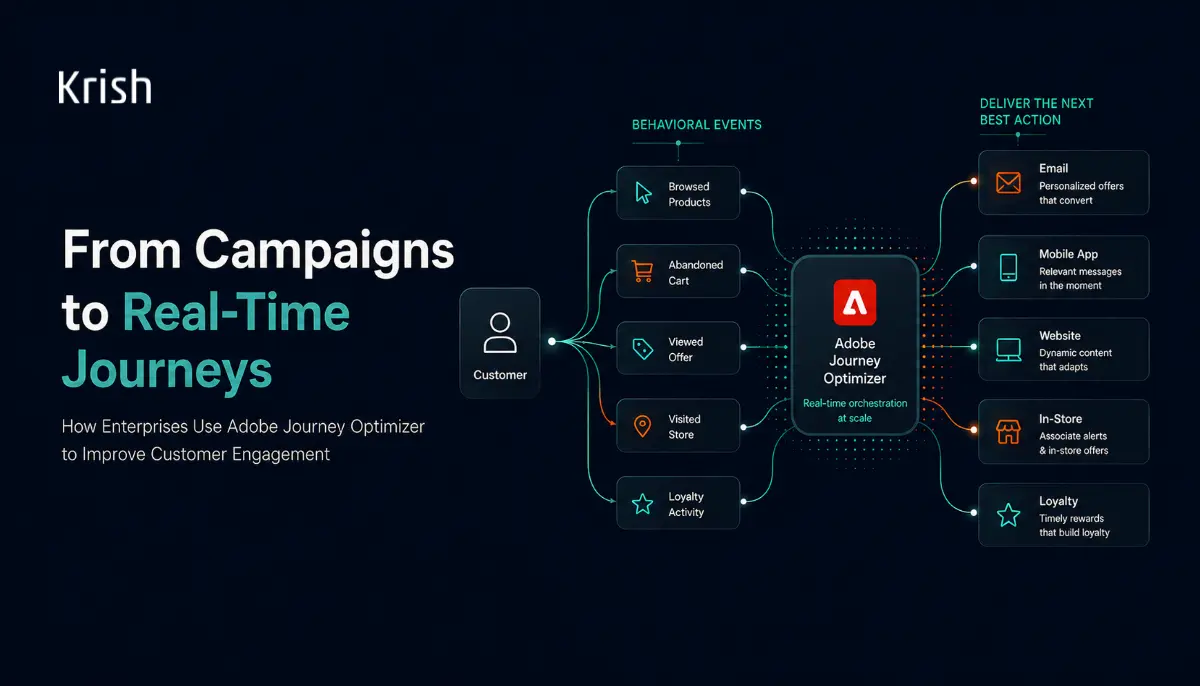
How Enterprises Use Adobe Journey Optimizer to Improve Customer Engagement
20 April, 2026 Brands are sitting on petabytes of customer data, yet 76% of consumers still experience deep frustration when interactions feel entirely generic, as revealed by McKinsey. Marketing teams know the gaps exist. They see the abandoned carts, the unread emails, and the fragmented experiences across channels. The problem is rarely a lack of intent. It is a lack of architectural capability.
Subscribe with Us!
Never miss any post, stay tuned!
Trusted by leading brands


